A hard workout can leave you tired. Disciplined training changes how you show up when you are tired, frustrated, busy, or unsure of yourself. That is why people searching for the best martial arts for discipline should look beyond the style name and pay attention to the training culture, coaching, and standards inside the gym.
The right martial art gives you a reason to arrive consistently, a process to follow, and honest feedback when your technique or effort needs work. It teaches you to stay composed under pressure instead of quitting when things get uncomfortable. For adults balancing work and family, teens building confidence, and athletes who want to perform at a higher level, that structure can carry well beyond the mat or bag.
What Makes a Martial Art Good for Discipline?
Discipline is not simply doing difficult things. It is doing the basic things correctly, repeatedly, even when nobody is watching. In martial arts, that may mean wrapping your hands before class, drilling footwork with attention, keeping your guard up late in a round, or returning after a tough sparring session with a better attitude.
The strongest programs for discipline usually share a few traits: clear technical standards, progressive instruction, physical conditioning, accountability, and a coach who corrects details instead of letting students coast. A style can be effective on paper, but if training is casual and inconsistent, it will not build the habits most people are looking for.
You should also consider what will keep you engaged. The most demanding art is not automatically the best choice if you dread every class and stop attending after a month. Real progress comes from training you can commit to week after week.
Best Martial Arts for Discipline: Top Choices
Muay Thai: Discipline You Can Feel Every Round
Muay Thai is one of the best choices for people who want discipline tied directly to fitness, composure, and practical striking skill. Training demands attention to stance, balance, timing, defense, conditioning, and controlled power. There is very little room to fake effort when you are hitting pads, working the bag, drilling combinations, or completing rounds with a partner.
The discipline comes from repetition and responsibility. You learn that a lazy guard creates openings, poor conditioning affects technique, and rushing combinations leaves you off balance. Every class gives you measurable feedback. Did your movement improve? Can you stay calm under fatigue? Are you listening closely enough to apply a correction on the next round?
Muay Thai is especially effective for adults who want a challenging alternative to a standard gym workout. It combines skill development with demanding conditioning, so you are not just counting reps. You are learning to control your body and make decisions while your heart rate is up.
There is a trade-off. Muay Thai requires patience. Beginners will not look polished right away, and good technique takes time. That is exactly why it builds discipline. You have to accept being new, focus on fundamentals, and earn improvement through consistent work.
Brazilian Jiu-Jitsu: Patience, Problem-Solving, and Humility
Brazilian Jiu-Jitsu develops discipline in a different way. Instead of exchanging strikes, students learn to control position, escape bad situations, and apply submissions through leverage and timing. Sparring, often called rolling, quickly exposes gaps in technique and decision-making.
For people who enjoy problem-solving, Jiu-Jitsu can be a powerful discipline builder. You cannot force every situation with strength. You have to stay patient, manage frustration, and think several steps ahead. It is also humbling. Everyone gets caught, pinned, or outmaneuvered at some point, including experienced students.
The downside for some people is that progress can feel less straightforward at first. Classes may involve a lot of close-contact grappling, and the learning curve can be frustrating if your main goal is striking fitness or high-energy conditioning. Still, for students who want to develop calm thinking under pressure, it is an excellent option.
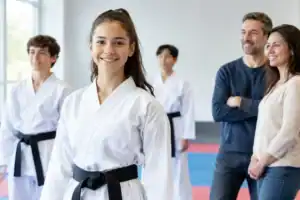
Karate: Precision and Respect for Process
Traditional karate schools often place a strong emphasis on etiquette, forms, stance work, and rank progression. Students may bow at the beginning and end of class, follow structured lines, practice formal techniques, and test for belts based on specific requirements.
That structure can be highly effective for young students and adults who respond well to clear milestones. Karate teaches that details matter. How you stand, where your hands are placed, and whether you execute a movement with control are all part of the lesson.
The quality of instruction matters greatly here. Some schools focus heavily on performance for belt tests without enough realistic application or conditioning. Others balance traditional values with strong athletic training. Visit a class, watch how instructors correct students, and ask what a beginner is expected to practice between sessions.
Judo: Commitment, Balance, and Controlled Aggression
Judo builds discipline through throws, grips, takedowns, and ground control. It requires sharp timing and a willingness to practice techniques repeatedly until they become reliable. Students must also learn how to fall safely, which is a useful skill and a lesson in trust and body awareness.
Because judo training involves live resistance, it teaches respect quickly. A technique that works against a compliant partner may fail when someone is moving, gripping, and resisting. That reality encourages patience and technical precision.
Judo can be physically demanding on the body, particularly with frequent throwing and falling. It may not be the best fit for everyone with existing joint concerns, although a qualified coach can help modify training. For those who enjoy grappling and explosive movement, it offers a disciplined, competitive environment.
Boxing: Consistency Under Pressure
Boxing is direct, demanding, and highly effective for building work ethic. Good boxing training develops footwork, defensive awareness, timing, conditioning, and precise punching mechanics. It also teaches students to remain focused when a partner is moving toward them with real intent.
The training rhythm is one reason boxing works so well for discipline. Rounds have a clock. You cannot negotiate with the bell. You learn to manage your pace, recover between rounds, and keep working when your shoulders burn.
Boxing does not include kicks, knees, elbows, or grappling, so it is more specialized than Muay Thai or mixed martial arts. But for someone who wants practical hands, serious conditioning, and a simple path to measurable improvement, it remains a strong choice.
How to Choose the Right Style for You
Start with the outcome you want, not the trend you see online. If you want full-body conditioning, practical striking, and confidence under pressure, Muay Thai is hard to beat. If you want patient problem-solving and close-range grappling, Brazilian Jiu-Jitsu or judo may fit better. If formal structure and rank progression motivate you, karate may be the right environment.
Then evaluate the school. Watch whether beginners receive real coaching or get lost in a crowded class. Notice if advanced students train with control and respect. Ask how the program handles conditioning, sparring, safety, and individual goals. A good gym should challenge you without making you feel like you must already be an athlete to belong there.
For parents, the instructor’s ability to create structure is especially important. A youth program should set expectations, reinforce respect, and make training enjoyable without turning every class into unstructured play. Young students need encouragement, but they also benefit from learning that effort, attention, and consistency matter.
Discipline Is Built Between Classes Too
Training two or three times per week can change your routine, but only if you support it with simple habits outside the gym. Pack your gear the night before. Put class times on your calendar like an appointment. Eat and hydrate in a way that lets you train with energy. Keep a short note after class about one correction you need to remember.
Do not chase perfect motivation. Motivation comes and goes. Discipline is deciding that you will attend, learn, and work with intent even on the days when you would rather stay on the couch.
At Beltrante Fighting Systems, beginners do not need prior experience to start building those habits. The goal is not to prove you are tough on day one. It is to show up, learn the fundamentals, and push yourself with the guidance of a coach who pays attention.
Choose the martial art that makes you want to return, then give it enough time to challenge your excuses. A focused hour of training can become the part of your week that reminds you what you are capable of when you stay consistent.